



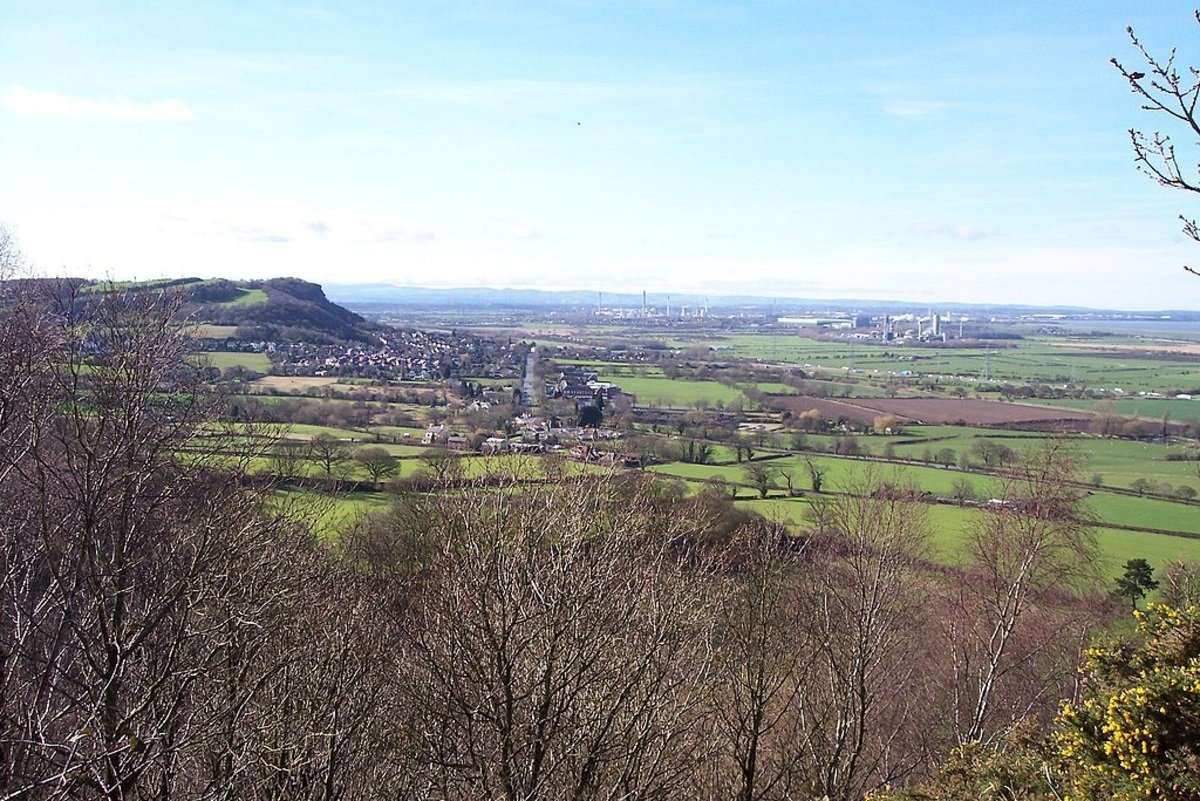

The countryside between Frodsham and Helsby, near the village of Alvanley in North Cheshire is a beautiful rural area. And yet for more than 50 years, a former refuse tip in this area known as Commonside has been quietly leaching toxic and carcinogenic chemicals into a local watercourse. This has been known to the local authorities, the Environment Agency and its predecessors and has been a constant, nagging worry for residents. How can this happen in our environment conscious, regulated society?
Today, nature is slowly reclaiming Commonside. It is not classified by Cheshire West and Chester council (CWAC) as contaminated. There are no warning signs, no fences. At its bottom end runoff from the tip trickles over an unnatural orange coloured mud bank into a pool of discoloured water before running down to the nearby Foxhill Brook.
The story of Commonside tip
Commonside started operating as a waste tip sometime in the 1950s and continued in use until the 1970s. Ever since, there has been persistent concern that the tip contained Polychlorinated biphenyls (PCBs) – a class of long lasting, highly toxic and carcinogenic chemicals – and that these chemicals were being leached from the site into local streams. An ITV This Week documentary which aired in October 1989 exposed these concerns.
In a 1990 letter to a Helsby based environmental group, the National Rivers Authority (NRA) reported that it was in contact with the then owner of Commonside, about remedial works, and “It is the owner’s intention to try to persuade the manufacturer of the PCBs, Monsanto Limited and the producers of the waste, BICC Ltd, and various other companies in the Ellesmere Port area to contribute to the cost of the clean-up”
At this time, BICC (now Balfour Beatty) operated a large factory in Helsby making cables and electrical equipment (which would certainly have included PCBs). The plant eventually closed in 2000. Monsanto manufactured PCBs in the UK at plants in Newport and Ruabon until the 1970s when PCBs were banned.
There is limited publicly available information on exactly what went into the tip. A 1992 report from the NRA states, “The site was originally an unlicensed and uncontrolled Central Electricity Board fly ash tip. The fill was placed over a watercourse which was poorly culverted. Subsequent use of the site has been for tipping industrial wastes, petrochemical sludges, redundant transformers and oil”. (Appendix D3.3)
The NRA also noted that, “Significant levels of PCBs have been found to be present below the point of discharge in the local watercourse.”
Prosecution … but then nothing
The NRA was convinced something had to be done. The government refused an application for a grant to clean up derelict land, on the grounds that, “On the evidence available to us, Commonside Tip, although apparently a source of pollution, is not itself derelict”. [Letter from Environment Secretary, Michael Howard to local MP Alastair Goodlad, dated 09 December 1992]. The responsible local authority, Vale Royal borough council, declined the government’s offer of a £2mn loan. Whether or not Monsanto and BICC were approached is unknown, but if so, all attempts to raise funding were unsuccessful.

The NRA served enforcement orders on, and eventually prosecuted, the tip owner on 3 counts of causing pollution. The judge dismissed an attempted defence, the tip owner pleaded guilty, was fined £250 on each count and had to pay NRA costs. However, the court accepted the owner did not have the means to pay for remedial works.
Efforts to deal with pollution from Commonside were stalled at this point. In 1996, the Environment Agency was created by merging the NRA, Her Majesty’s Inspectorate of Pollution and some local authority waste regulation functions.
New responsibilities for local authorities
The Environment Protection Act of 1990 and subsequent amendments made it the responsibility of local authorities to determine whether their land was contaminated.
According to the government, land is legally defined as ‘contaminated land’ where substances are causing or could cause:
- significant harm to people, property or protected species.
- significant pollution of surface waters (for example lakes and rivers) or groundwater.
- harm to people as a result of radioactivity.
In 2004, Vale Royal council started the process of determining the status of Commonside by commissioning a consultancy, Geodelft, to investigate the tip. They drilled boreholes around the perimeter of the tip and took water and sediment samples from Foxhill Brook. In 2006 a further study was done by another consultancy, RSK, which sampled a number of points in Foxhill Brook; both water and sediment samples were taken. In 2009, RSK did a further survey, based on water and sediment samples. The various reports have been obtained through a freedom of information request. They show high levels of PCBs were found in stream sediments at various points on Foxhill Brook.
In 2009, Vale Royal borough council became part of Cheshire West and Chester unitary authority. As reported on their website, the council concluded in 2009 – presumably based on the RSK report – that Commonside tip was not contaminated land. This is now being looked at again, because of “concerns raised by a member of the public”.

Enter Paul Cawthorne, vicar and campaigner
Paul Cawthorne is a tireless campaigner on the issue of PCBs and the unsatisfactory way in which their removal from the environment has been handled. He has documented his battles in our sister publication, Bylines Cymru. Realising the scope of the problem was UK wide, Paul has identified Commonside tip – and the nearby BICC site in Helsby – as among his priorities for action.
Cawthorne comments, “Alvanley Commonside has been a nationally significant chronic leaking hazardous chemical problem recognised for over 45 years. That’s why two government ministers, the local MP and the chair of the National Rivers Authority were all discussing it in the early 1990s. It seems irrational and potentially collectively negligent to have prosecuted the site owner then done nothing to stem the toxic flow, doesn’t it? Even more surprising the Council, following receipt of local consultancy firm RSK’s report showing extensive PCB in the watercourse below the site, chose not even to classify the site as contaminated land. Is that perhaps because national officials realised early just how big a problem it is, as a high-level document shows?”
“Like internationally notorious Maendy quarry PCB dump in South Wales, PCB-contaminated livestock are recorded below the site. The PCB-contaminated Foxhill Brook below Commonside runs into the Mersey, as does the PCB-contaminated Hornsmill brook at Helsby BICC factory. The Mersey has some of highest fish and shellfish neurotoxic PCB readings in the whole U.K. Maybe that isn’t just coincidence?”
“As more of these hazardous chemical barrels at Commonside continue to rust and leak their deadly contents, the problem below the site may increase not decrease with time, scientific reflection suggests.”
Through freedom of information requests, Cawthorne has obtained key documents containing the results of several surveys undertaken for Cheshire West and Chester Council (and its predecessor). Other valuable historical documents and correspondence belonging to local residents have come to light. An independent survey which contains an invaluable analysis of the dispersal of contaminants from Commonside was conducted by the University of Liverpool.
Commonside 50 years on
In summary, 50 years of admiring the problem has resulted in almost no change. While there is a mass of data now available, Commonside tip is not classified as contaminated land, even though there is clear evidence it is releasing PCBs which are significantly polluting nearby waters.
- The NRA and the UK Government acknowledged there was pollution in the 1990s.
- The former owner of the tip was prosecuted and convicted for pollution offences in 1994.
- Liverpool University and RSK found high levels of PCB in stream sediment. Whereas the normal background level of PCBs in soil is 1-2ppb (parts per billion or micrograms/kg) Foxhill Brook has been shown to have up to 13771ppb in stream sediments [RSK survey 2009, FOI request] and the sump close to the tip over 240000ppb.
- In 2009 Cheshire West and Chester council employed RSK to “remove contamination-impacted sediment” from Foxhill Brook. They were warned at the time that “these measures are temporary and over time organic matter will again build up along sections of the Brook” [extracts from letter from RSK to CWAC, 17 April 2009, FoI request].
PCBs are no longer manufactured, and disposal of equipment that contains them is strictly regulated. Levels of PCB in soils are declining. The landfill sites that are releasing PCB-laden wastes are becoming more and more significant sources of PCB getting into the environment, where they persist and are concentrated in food chains. It is past time to deal properly with Commonside tip. Formal acknowledgment by the local council and the Environment Agency that Commonside tip is indeed contaminated land is a long-overdue starting point for meaningful remediation.



