





Disclaimer: Based on real events, presented through satire. No allegation of illegality is made.
Rupert Lowe’s story is what happens when Britain’s insurgent right stops pretending it is a protest and starts auditioning for power. Not power in the boring, policy-wonk sense, but power as performance, power as punishment, power as a national purge with a logo and a mailing list. The break with Reform UK and Farage did not just produce another vanity splinter, it exposed a deeper split in the genre itself. One side wants a permanent grievance engine that barks at Westminster from the sidelines. The other wants a “restorationist” project that tries to seize the megaphone and rewrite the rules of the country from the top down.
Lowe did not simply fall out with Nigel Farage, he tried to replace the model Farage built.
The Reform UK fallout, and the shape of the fight
The rupture reached its public peak in March 2025, but by then the relationship had already rotted. The argument was never only about ego, it was about control. Reform UK is built around a charismatic centre – a leader who performs as the party. Lowe’s critique, when it landed, was aimed straight at that structure.
On 5 March 2025, Lowe gave an interview that detonated the relationship. He described Reform UK as a “protest party led by the Messiah”, a line designed to wound. His message was that Farage could start a movement but could not build a proper party of government. He pushed the idea that Reform lacked a professional frontbench and a serious plan, hinting he would not stand beside Farage at the next election without dramatic improvements.
This is the point where the soap opera becomes a power struggle. Farage responded quickly, dismissing the claims and noting that with so few MPs, Lowe was already effectively part of the front bench. The dispute reportedly became personal, with accusations that Lowe was damaging the party before elections “Disgusting”.
In a post on social media, Mr Lowe said the alleged leaked messages “prove that he [Mr Farage] kicked me out of the party and launched this malicious witch hunt because I dared to ask reasonable questions of Reform”
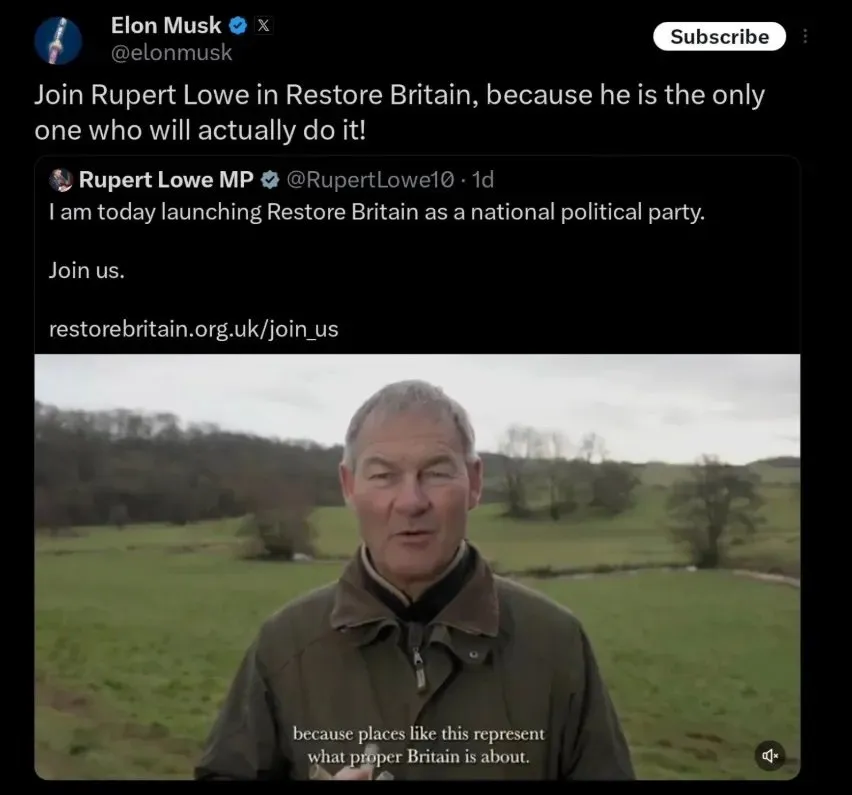
Hovering over this was billionaire attention – the Musk factor, online endorsement and the suggestion that Farage was not extreme enough for certain corners of the digital right. Whether organised or not, that support fed a narrative that Lowe was the “shadow leader”.
That narrative matters because it changes how everyone behaves. Once a politician believes they have outside backing, they stop negotiating and start conquering. Once their opponents believe it, they stop tolerating and start removing.
Suspension, bullying allegations, and the Perry KC Report
Reform UK suspended Lowe on 7 March 2025, citing a “disturbing pattern of behaviour”, including allegations of bullying and harassment. The party commissioned Jacqueline Perry KC to investigate complaints made by two female staffers. The report, published on 25 March 2025, described “credible evidence” of a toxic office culture. The key theme was not a single incident, but an atmosphere of toxicity. One complainant, described as a seasoned parliamentary employee, alleged constant criticism delivered harshly. The report also described Lowe’s response to that complaint as dismissive, backing a male staffer and telling the woman she could make other arrangements if unhappy.
Another complainant, linked to Mr Lowe’s constituency office, alleged unacceptable WhatsApp remarks, including being called “weird” and references to autism. The report’s framing was that Lowe failed or was unwilling to deal with toxic conduct by male staff, contributing to an environment of victimisation. The report also warned that some alleged conduct carried a risk of breaching the Equality Act 2010, given the discriminatory flavour described in the messages.
Lowe rejected the report completely, describing it as biased and malicious, and reframing it as “woke HR lawfare”. This is a familiar move in contemporary right-populist politics. If someone accuses you of mistreating staff, you do not argue about management culture, you argue about ideological conspiracy. You do not deny there was conflict, you claim the conflict is the proof you are a truth-teller being targeted by the system.
Perry KC reportedly refuted the idea that the complaints were retaliatory, citing internal complaints that pre-dated Lowe’s criticisms. If that timeline stands, it matters. It would suggest this was not simply an opportunistic smear timed to silence a critic, but a simmering workplace issue that finally collided with a political divorce.
None of this makes Lowe guilty of anything criminal, and this is not a courtroom. But in politics the test is not legality alone; it is whether you can run an organisation without it imploding.
The Zia Yusuf allegations and police referral
Reform UK leadership also referred Lowe to the Metropolitan Police over allegations of verbal threats directed at party chairman Zia Yusuf, which Lowe denied. The party said the incidents occurred on at least two occasions between December 2024 and February 2025.
This is the kind of detail that turns an internal party conflict into national news, and it is also the kind of detail that can be used as a political cudgel even if nothing follows. In this case, it did not. The CPS later decided not to charge Lowe.
After suspension, Lowe reportedly called Reform’s leadership vipers, failed ministers, a cult. That language matters too. It signals that Lowe was not looking for reconciliation. He was looking to burn the bridge, salt the river, and build his own road.
Restore Britain, from movement to party
That road became Restore Britain.
Restore Britain started as a non-party issue-based membership. Lowe launched it initially as a movement on 30 June 2025, framed as an issue-based pressure group designed to shape debate and build a platform for national “restoration”. The branding was pure nostalgia-politics. Restore what, exactly. A stable NHS? Affordable housing? Functional water companies? Or the mythic Britain of flags, punishment, and cultural homogeneity?
On 13 February 2026, he formally registered Restore Britain as a political party, promising hundreds of candidates from outside the establishment. That is the transition from influencer to operator. It is also the moment when all the earlier drama looks less like an unfortunate implosion and more like a deliberate escape velocity plan.
Restore Britain’s organisational model is described as decentralised – an umbrella structure partnering with local groups while maintaining national policy coherence. The cited example, “Great Yarmouth First”, illustrates this approach. It avoids building a national machine from scratch, but also creates distance between the centre and controversial local candidates.
The platform, and the hardline turn
This is where the “ideological divergence” becomes clear. Reform UK pitches populism in largely secular terms. Restore Britain adds explicitly moral language, foregrounding “Christian principles” and Britain’s “Christian heritage” as political foundations.
On immigration, the platform shifts from management to reversal. Lowe’s rhetoric, as described, involves rounding up criminals who entered illegally and removing them rapidly, advocating removal of benefits for foreign nationals, and revocation of citizenship for dual nationals involved in organised sexual exploitation. These are deliberately maximalist positions. They are designed to feel like action, even when the logistics, legality, and collateral damage are ignored.
On “anti-Islamification”, proposals include bans on halal slaughter, making Sharia courts illegal, and banning the burqa in public. Packaging these as “one rule of law” is politically useful, but it also blurs into collective suspicion and cultural punishment. When you target faith-linked practices as a bloc, you are not just arguing about law, you are signalling who belongs.
The £600,000 crowdfunded inquiry
A central early initiative was Lowe’s private inquiry into grooming gangs, branded online as the “Rape Gang Inquiry”. He argued the government’s statutory inquiry was too slow and insufficiently focused on ethnicity and religion. Again, there is a real question about institutional failure and fear of controversy. But there is also a political temptation, take a true scandal, emphasise its most combustible angles, and build a permanent outrage generator.
The Crowdfunder campaign raised about £600,000 from roughly 20,000 donors, with 13 donors exceeding the £1,500 reporting threshold. Lowe described the funding as “entirely grassroots”, while critics pointed to the large donors as possible seed money that gave the project momentum.
In July 2025, Lowe was investigated by the Parliamentary Commissioner for Standards over late registration of the funds and was cleared, reportedly because the funds were not accepted until 23 June 2025 Cleared means within the rules; it does not settle questions about optics.
Public hearings began in London on 2 February 2026. Evidence and allegations presented included claims about victims trafficked abroad, including to Pakistan, and institutional reluctance to confront perpetrators due to community cohesion concerns. If those failures occurred, they deserve forensic investigation. But private inquiries also raise questions about standards, safeguarding, evidentiary rigour, and whether the purpose is justice or campaigning.
The stated legal objective included pursuing private prosecutions where the state had failed. That can sound righteous, but it can also become weaponised. Private prosecutions can be used responsibly, and they can be used to create pressure, headlines, and political theatre. The line between accountability and spectacle is thin, and Lowe’s timing, with a party launch days after high-profile hearings, makes that line impossible to ignore.
What this all adds up to
Rupert Lowe’s trajectory is a case study in modern populist politics. Personal conflict becomes ideological schism. Organisational disputes become moral crusades. Workplace allegations become culture war “lawfare”. Fundraising becomes legitimacy. A private inquiry becomes a platform. A platform becomes a party.
Whether Restore Britain becomes a serious electoral force or just another right-wing shatter-splinter depends on resources, discipline, and whether voters want governance or vengeance. But the intent is clear. Lowe is trying to move beyond Reform’s protest posture into a “national vanguard” posture, a project that frames itself as the rescue of the nation from decadence, softness, and betrayal.
When a man turns allegations, institutions, and survivors into stepping stones for his own brand, that is not “restoring Britain”. That is just another bloke trying to franchise the country’s anger with rage and a crowdfunder link.


Friends of Bylines Network
There has never been a greater need for grassroots journalism that investigates the stories that really matter, holds power to account and champions the voices of everyday citizens. We are proudly powered by volunteers but what we do isn’t free.
STAND WITH US for independent, citizen-led journalism that makes democracy stronger, and you will even get some exclusive benefits.


