


• Contact
  • About
  • ISSN 3049-9755
  • Authors and editors
NEWSLETTER SIGN UP
North West Bylines
Advertisement
  • Home
  • News
    • Crime and Justice
    • Education
    • Equality
    • Health
    • Migration
    • War
    • World
  • Environment
    • Nature and Wildlife
    • Pollution
  • Politics
    • Brexit
    • Economy
  • Lifestyle
    • Art, Craft and Photography
    • Cartoon
    • Books
    • Culture, Language and Religion
    • Dance
    • Food and Drink
    • History
    • Human Interest
    • Music
    • Sport
    • TV, Film and Theatre
  • Business
    • Local Business
    • Technology
    • Trade
    • Transport
  • Region
    • Cheshire
    • Cumbria
    • Greater Manchester
    • Lancashire
    • Liverpool and Merseyside
    • Local Councils and Elections
No Result
View All Result
North West Bylines
Home Region Greater Manchester

Andy Burnham’s No 10 North has a precedent – in medieval York

A No 10 North in the North of England is going to shift power away from London, and Andy Burnham is not the first to make that decision

Stephanie Brown by Stephanie Brown
01-08-2026 07:13
in Greater Manchester, History, Politics
Reading Time: 8 mins read
A A
Man in a white polo shirt speaks at a political rally as a crowd behind him holds bright pink signs reading 'ANDY FOR US'.

Picture by Bylines Team

Share on Bluesky

Andy Burnham’s decision to establish No 10 North, a permanent northern base for the prime minister’s office, has been hailed as an ambitious shift in state power.

Supporters see it as a long-overdue attempt to rebalance political power away from Westminster. Critics have questioned the practicalities of moving part of the machinery of government beyond London.

The idea that England has always been governed from a single political centre is surprisingly recent. Westminster may now appear almost inseparable from the state, but for much of English history, government was far more mobile.

The royal household, senior officials, courts, records and administrative departments moved with the monarch, creating what historian J.E.A. Jolliffe called “a government of the roads and the roadsides”. The scale of this movement could be extraordinary. At the height of his reign, King John (who reigned from 1199 to 1216) relocated his court and government on average 220 times a year.

Other historical centres of power include Winchester, which served as the political heart of pre-Conquest England. During the English civil war (1642-1651), Charles I established Oxford as the Royalist capital, because parliament controlled London.

But these examples are not quite the same as Burnham’s No 10 North. Winchester was an early royal capital – before Westminster, rather than alongside it. Oxford was the capital of the king, but not of parliament.
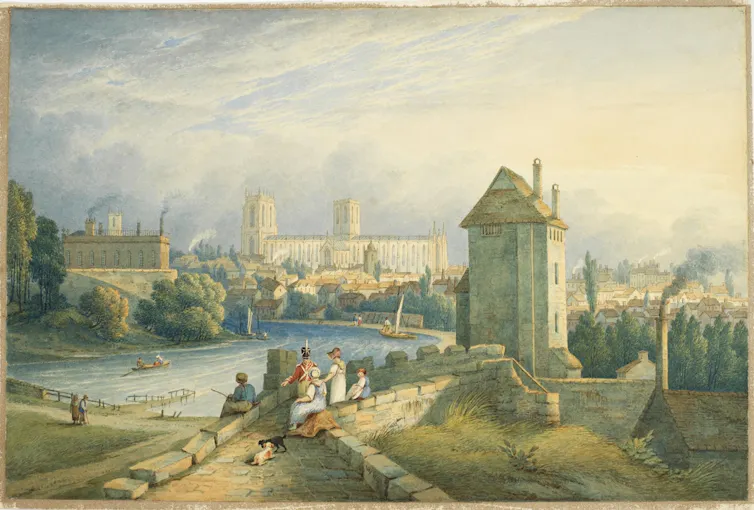
Old painting of York city
View of York from the Castle Walls by John Frederick Lewis (1829). The Courtauld

York was different, however. Between 1298 and 1337, three successive English kings repeatedly transferred major parts of their central administration to York. Parliament met in the newly completed chapter house of York minster.

The city’s sheriff was ordered to construct the distinctive chequered table used by the Exchequer, and prepare secure accommodation for the royal treasury inside Clifford’s Tower. York castle was adapted to house the two principal common law courts, King’s Bench and Common Pleas.

York even witnessed a royal wedding when Edward III married Philippa of Hainault in the minster in 1328. For extended periods, York was the closest England came to having two administrative centres.

Why York?

By the late 13th century, York was uniquely equipped to play this role. It was the largest and wealthiest city in England after London. Situated on the tidal River Ouse, it was connected directly to the Humber and the North Sea, making it one of England’s most important commercial centres. Major roads converged on the city, giving it communications second only to London.

York was also already a centre of authority. It was the county town of Yorkshire, England’s largest shire, and the seat of the archbishop of York, whose ecclesiastical province stretched across much of northern England. The city already possessed many of the things a government needed: accommodation, administrative experience, skilled clerks, commercial wealth and political prestige.

Edward I from a portrait in Westminster Abbey.
Edward I from a portrait in Westminster Abbey. WikiCommons

Edward I’s wars against Scotland made governing from Westminster increasingly difficult. York offered proximity to the northern frontier while still providing the infrastructure required to administer a kingdom.

But military necessity was only part of the explanation for this move. Edward also had political reasons for looking beyond London. Following tensions with the city’s political elite in 1297, York offered the king an alternative base of operations away from the capital.

Westminster’s eventual position as England’s political centre was far from inevitable. It was the demands of the Hundred Years’ War (1337-1453) between England and France that helped draw the institutions of government permanently towards Westminster.

Yet a different outcome was possible. As argued by Mark Ormrod, had Edward III continued to prioritise Scotland instead of France: “York, rather than Westminster, might have been chosen as the heart of a new-style Plantagenet empire.”

No 10 North is not a medieval revival. Edward I moved his government north because of war, royal politics and the practical realities of medieval kingship, not because he sought to reduce regional inequality or rebalance the relationship between London and the rest of England. The motivations are entirely different.

Yet the historical comparison matters because it challenges a persistent assumption: that England has always been governed exclusively from London. Westminster’s dominance can appear timeless, but it is the result of historical change rather than inevitability. For much of the middle ages and early modern period, the location of government remained flexible.

Whether No 10 North succeeds in reshaping the relationship between Westminster and the regions is a question for contemporary politics. History cannot answer that. What it can show is that relocating the government beyond London is not without precedent.

England has experimented with multiple centres of power before – and for a time, York showed that a different seat of government could work.


Stephanie Brown, Lecturer in Criminology, University of Hull

The Conversation

This article is republished from The Conversation under a Creative Commons license. Read the original article.



Andy Burnham against a blue background

Burnham’s alternative welfare reform for Greater Manchester

18 July 2025
man in dark suit wearing glasses, against a red background and with a talk bubble that says 'the water industry is broken'

Burnham: “the water industry is broken”

3 June 2026
    Superb piece.  It deserves a coffee…

Friends of Bylines Network

There has never been a greater need for grassroots journalism that investigates the stories that really matter, holds power to account and champions the voices of everyday citizens. We are proudly powered by volunteers but what we do isn’t free.

STAND WITH US for independent, citizen-led journalism that makes democracy stronger, and you will even get some exclusive benefits.

BECOME A FRIEND
Previous Post

Earth’s Follies – Week 76: Fourth terms, and gold statues

Next Post

Oldham Council declares it is breaking the law

Stephanie Brown

Stephanie Brown

Related Posts

People working in a field, carefully digging and looking for Roman finds
Cheshire

Roman villa excavation in Rossett reveals secrets

by University of Chester
7 October 2026
Signpost 'charity' against a blue skt
Education

Accounting students put their skills to work helping Manchester charities

by Manchester University
6 October 2026
Dr Perera producing a painting, a close-up of two hands holding a small paintbrush to create exquisite art
Art, Craft and Photography

UN SEEN ME, The journey from clinician to artist

by Anna Schurer
3 October 2026
Rocky red surface with two haggis hiding behind a rock, each wears a tartan hat, and a robot on the other side of the rock
Opinion

Earth’s Follies – Week 84: Super Intelligence and the Schmitt Show

by Xylb-tok the Martian
2 October 2026
red picture with in white 'Labour Party Conference 2026'
Opinion

Labour Party conference impressions

by Anna Schurer
2 October 2026
Next Post
Shopping centre with cone shaped top floor

Oldham Council declares it is breaking the law

SUPPORT OUR CROWDFUNDER

BROWSE BY TAGS

A day in my shoes AI by-election Charity Christmas coal mine Conservatives Coronation Cost of living Democracy Energy Eurovision EU support farming Festival Finance Gaza Homeless housing HS2 Labour Levelling up Liberal Democrats Long Read mayoral election minneapolis NI Protocol obesity poetry Poverty press release Press Releases recycle Reform Reviews riots Russia Satire SEND Sewage trans Ukraine water women xylb'tok
North West Bylines

We are a not-for-profit citizen journalism publication. Our aim is to publish well-written, fact-based articles and opinion pieces on subjects that are of interest to people in the North West and beyond.

North West Bylines is a trading brand of Bylines Networks Limited which is separate to, but allied with, Byline Times.

Learn more about us

No Result
View All Result
  • About
  • Authors and editors
  • Complaints
  • Contact
  • Donate
  • Letters
  • Privacy
  • Network Map
  • Network RSS Feeds
  • Submission Guidelines
  • Download the Bylines Network App

© 2022-2026 North West Bylines. Powerful Citizen Journalism. ISSN 3049-9755

No Result
View All Result
  • News
    • Crime and Justice
    • Education
    • Equality
    • Health
    • Migration
    • War
    • World
  • Politics
    • Brexit
    • Economy
    • Opinion
  • Environment
    • Nature and Wildlife
    • Pollution
  • Lifestyle
    • Art, Craft and Photography
    • Books
    • Culture, Language and Religion
    • Dance
    • Food and Drink
    • History
    • Music
    • Sport
    • TV, Film and Theatre
  • Business
    • Local Business
    • Technology
    • Trade
    • Transport
  • Region
    • Cheshire
    • Cumbria
    • Greater Manchester
    • Lancashire
    • Liverpool and Merseyside
    • Local Councils and Elections
  • Cartoon
  • Authors and editors

Newsletter sign up

CROWDFUNDER

© 2022-2026 North West Bylines. Powerful Citizen Journalism. ISSN 3049-9755