




In the run-up to Christmas this year, not really feeling it, I thought I’d try to conjure the reluctant Christmas spirit within myself by supplementing my annual dips into It’s a Wonderful Life and the ghost stories of M R James with the daily perusal of a Christmas story by Dickens. There are, after all, just the five of them, and they’re novellas rather than novels, so I could squeeze them in somehow and still have time to rush around Chorley looking for chestnuts.
I found that three of the five have little to do with Christmas itself – though much to do with the ‘spirit’ which should attend it – and that the two which do, A Christmas Carol (1843) and The Haunted Man and the Ghost’s Bargain (1848), deserve to be read at any time of the year.
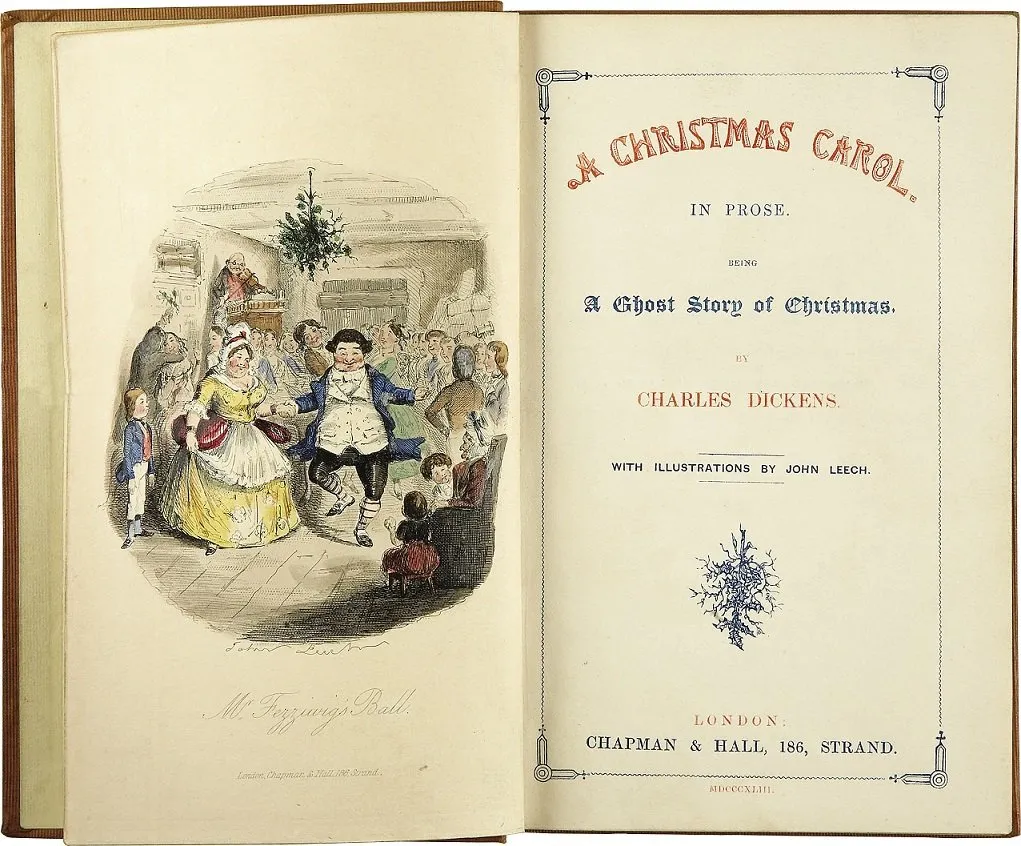
A Christmas Carol (1843)
I won’t say too much about the story. Most people know it. If they haven’t read Dickens’ actual prose version then they’ve more than likely seen a cartoon, or the Alistair Sim film, or the Muppets’ version, or Scrooged with Bill Murray, or one of innumerable other adaptations and versions in just about every medium in which it’s possible to tell stories.
One of my favourite uses of it was Tony Jordan’s 2015 20-part ten-hour BBC TV series, Dickensian, which cheekily, irreverently and often brilliantly used the death of Jacob Marley as the starting-point for a teasing, atmospheric, complex murder mystery featuring characters and locations from a slew of Dickens novels and stories. The great Stephen Rea was gloomily spellbinding as Inspector Bucket. This alone would have been enough for me.
Scrooge is a caricature miser. The Cratchits are caricatures of happy, loving poor people. Ebeneezer’s moral transformation is easily, perhaps too easily effected (he doesn’t really need the third ghost and scarcely requires the second). The street urchin who Scrooge sends to get the goose? Well, he was a local kid with local knowledge and would surely have bolted at the first word from the notorious misanthrope, or at least used some ripe street urchin epithets. None of it’s especially believable.
Scrooge is not so much a character as a symbol of what can lurk within us, of what’s left when we suppress our better instincts. He’s our nightmare-self: the love dismissed and forgotten, the compassion withered to a stump, the life reduced to bare, pointless existence. His rebirth after the visitations is less novelistic than mythological and his story, like those of so many characters from mythology, continues to fascinate and appal.
The Chimes (1844)
After the success of A Christmas Carol in 1843, Dickens wrote The Chimes in time for publication in December 1844. Since massively overshadowed by the iconic status of its Scrooge-led predecessor, The Chimes was hugely popular at the time and for many years afterwards. It’s as you might expect from the Victorian maestro: beautifully written, emotionally affecting and socially crusading.
Humble, self-effacing ticket-carrier Toby ‘Trotty’ Veck; his virtuous daughter, Meg; and her upright, honest fiance, Richard, scratch a precarious living. A chance encounter with the bumptious, hypocritical Alderman Cute and his Malthusian friend reinforces their tendency to think of themselves as worthless, ‘surplus’ bits of the population who have little right to exist. That night, the chiming bells of the local church call to Trotty. He goes out into the night, ascends to the belfry and… well, you’ll have to read it for yourself.
My favourite touch – there are usually several to choose from in anything by Dickens – is when Alderman Cute interrupts Trotty’s outdoor meal. The Alderman and his friends ‘prove’ that Trotty’s repast is an offence to rational economics:
“‘Then I’ll tell you something. You snatch your tripe, my friend, out of the mouths of widows and orphans.’
“Trotty was so shocked, that it gave him no concern to see the Alderman finish the tripe himself. It was a relief to get rid of it, anyhow.”
Dickens, as ever, mercilessly satirises the way that the rich and powerful use the wretched cant of morality, law and reason to justify the continued oppression – and even the eradication – of the poor. Nearly two hundred years on, Dickens’ social analysis is still sadly, tragically resonant.
The Cricket on the Hearth (1845)
The Cricket on the Hearth was Dickens’ third Christmas book, published in December 1845. This one is even less obviously festive than The Chimes and is set in the last week of January. Still, it was offered up as a Christmas story, so let’s take it as such. It certainly harps on Dickens’ favourite themes – domestic affection, home and hearth as the main source of happiness, benevolence as the cardinal virtue, the conversion of the sinner – though unlike its predecessors it eschews supernatural elements.
John Peerybingle, a carrier; his younger wife, Dot; their baby and its nursemaid, Tilly Slowboy, live a contented life. One winter evening a mysterious stranger, an old man, is picked up by John and requests a few nights stay with them. Dot is concerned that her friend, May Fielding, is going to marry the old miser, Tackleton; her sweetheart Edward believed to be dead after going to South America. Tackleton employs/exploits Caleb Plummer, a kindly toymaker; and his blind daughter, Bertha, also a friend of Dot’s. Caleb has consistently deceived his blind daughter into thinking that their poor, sordid accommodation is quite luxurious and that Tackleton’s grim, misanthropic banter has always been sarcasm masking a benevolent, kindly soul. So far, so good. If you want more, read the story.
If you can accept Mr Rochester as a gypsy woman fooling anybody in Jane Eyre, I always say, then you pretty much have to accept anything the other Victorians deign to chuck your way. The Cricket on the Hearth is as preposterous as they come. Daft at times, frequently baffling, but worth it for all sorts of reasons: the Pickwickian conviviality of the party scene, the occasional bursts of matchless prose, and the gloriously comic/affecting portrayal of Tilly Slowbrook, ex-orphan, now child-endangering but golden-hearted nursemaid.

The Battle of Life (1846)
Dickens’ 1846 Christmas offering, The Battle of Life, is by far and away the least Christmassy of all his Christmas stories. In fact, it’s probably the least Christmassy Christmas story I’ve ever come across. The tale of the two Jeddler sisters, Grace and Marion, spans nine years with scenes set at various times of year, most frequently late summer/early autumn. Just one scene takes place around Christmas – by no means the most important one.
The plot involves a longstanding betrothal, an absent lover, a ruined libertine, an apparent elopement, conniving servants and a few other elements that were the stock-in-trade of Victorian authors of romantic mysteries. Years later, Wilkie Collins would go on to pour most of them into the mixture for some of his more determined challenges to reader credulity.
Still, as so often with Dickens, it’s not so much the plot that matters as the overdone characters, the grand conceits of the better prose passages and the dialogue. The Battle of Life is one of Dickens’ least popular, most neglected tales. I can see why. But it’s redeemed from the category of utter sentimental pointlessness, mostly by the scenes involving the two attorneys, Snitchey and Craggs, and partly by the servants, Clemency Newcome and Benjamin Britain. Hardly surprising. Dickens was often on top form with lawyers and servants, particularly lawyers.
Anyway, if you’re looking for a story to ramp up the Festive Factor you might be better advised to look elsewhere. If you’re a Dickens lover, however, and have, like me, always passed this one by, then it’s more than worth the hour or two it takes to read. Here’s a bit of Snitchey and Craggs to be going on with:
“‘I think,’ said Mr. Snitchey, ‘that I speak for Self and Craggs?’
“’Decidedly,’ said Craggs.”
The Haunted Man and the Ghost’s Bargain (1848)
Dickens didn’t write a Christmas book in 1847. A year later, he published the last of them, The Haunted Man and the Ghost’s Bargain.
In many ways it’s a re-run of A Christmas Carol. Redlaw is a teacher of chemistry at a gloomy old college. He is a solemn, solitary man who broods darkly over the past, particularly wrongs he feels were done to him (a harsh childhood, a friend’s betrayal). Like Scrooge, he has fond though embittered memories of a beloved sister. On Christmas Eve he is visited by a phantom, a ghostly version of himself who offers him the chance to have his memories of wrongs and sorrows erased along with the ability, simply by touching them, of erasing those of others. He clinches the awful bargain.
What follows is the most terrifying and affecting of all the Christmas stories since A Christmas Carol and the most overtly Christian of the lot. The style is often hallucinatory, nightmarish and chillingly atmospheric, especially when dealing with Redlaw alone in his rooms or in scenes with the strange, feral child who appears shortly after his unholy pact. At other times, with the servants William, Philip and Milly and the comically prolific, impoverished Tetterby family, Dickens infuses the scenes with all his accustomed warmth, generosity and pathetic humour. Without giving too much away, it is the intersection of these two worlds which creates the story’s terror and moral seriousness.
The Haunted Man and the Ghost’s Bargain is a curious tale which I for one – perhaps unduly influenced by my Christmas Day’s consumption of a skinful of Sauvignon Blanc, a few bumpers of Maker’s Mark, a couple of beers, a demi-carafe of Rioja, just the one brandy liqueur chocolate and a couple of flagons of residual Catholic guilt – found eerily unsettling.
Boxing Day
There. It’s Boxing Day. I’ve finished my Christmas Dickens books. Enjoyed them thoroughly, too, even the daft bits. As a result, I have been, I think, more susceptible to the soft, subtle promptings of the heart, more welcoming to the better angels of my nature, though this may simply be because I’ve not had to drive in traffic for a couple of days. The real test will come when the warm, slow fug of holiday lifts and we all get back to normal. Will I remember – in the car, navigating my trolley through the supermarket, on hold when trying to phone the surgery – the lessons of Tiny Tim, Trotty Veck, Dot Peerybingle, Clemmy Newcome and Milly William? Or will I simply re-connect with my inner Keith Talent? Note to self (pinned up on the dashboard): Dickens’ Christmas stories are for life, not just for Christmas.


