





Melissa Butcher, Royal Holloway University of London
“Nazi” and “fascist” are words being used a lot these days; thrown about as descriptions of contemporary populist leaders or to mark out disagreement with someone. Comparisons with 1930s Germany don’t always suit the complexity of the moment we live in, but there are resonances. The choices people are having to make in the face of authoritarianism is among them.
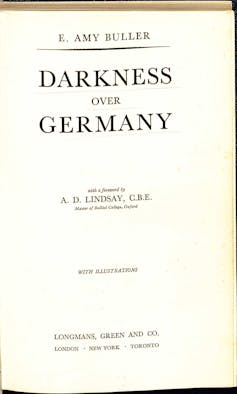
‘Darkness Over Germany’ describes the situation there in the 30’s
Darkness Over Germany, originally published in 1943, is a collection of conversations with people having to make difficult choices as the Nazi party gradually takes control of their country. The author, Amy Buller, lived and studied in Germany between 1912 and 1914, maintaining personal and professional networks there throughout her life.
Concerned by what she saw happening in the 1930s, she established an Anglo-German discussion group. She took academics from the UK to Germany to try to understand the country’s slide into dictatorship.
The conversations, with teachers, priests, military officers, tradesmen, civil servants, students and lawyers, point to some of the underlying economic and emotional drivers of authoritarianism. People speak of grievances related to humiliation and poverty. This is coupled with a desire for a leader who will make the pain of these things disappear
Make germany Great Again was one of Hitler’s slogans
Hitler promised to make Germany great again, for which some expressed gratitude, including a skilled tradesman who had spent four years in the trenches of the first world war: “I would ask you not to sneer at an honest attempt to meet a terrible situation and I might add that I am profoundly grateful to the Führer for this idea, which has saved my own sons from the destruction of unemployment.”
As Buller remarked in a lecture in 1942: “When men are drowning they will not be very particular about the type of rope that picks them up”.
Faced with fascism, ordinary Germans had to make difficult choices, described as “agony” by a teacher in Darkness Over Germany. At times, there is no good choice available. There were those who decided it was impossible to stay and chose exile. Some became less visible, keeping their heads down and letting it blow over, fatalistically choosing to do nothing because they felt there was nothing to be done.
There was a choice to stay but openly defy the authorities, possibly resulting in detention or worse. But also a choice to stay, pay lip service to the regime, and try to undermine it where possible, to prevent regime-aligned people taking up another place. There was also the option to join the regime.
All these decisions reflect how an individual may imagine the future, with despair for some but for others, a mercurial hope – that a new order will take away the humiliations of the past and bring economic prosperity. Or that the current moment is just an aberration and that this too will pass.
As a young German officer noted: “I would put up with almost anything if in my lifetime this feeling of defeat could be removed from the German army. I know much is bad in what the Nazis do, but it will not last. It is the sort of thing that happens in revolutions.”
Similarity to Trump’s re-election
These descriptions of personal responses to the rise of fascism in 1930s Germany echo what I heard in my research talking to voters across the US leading up to Donald Trump’s re-election. There is economic and social rupture as a result of globalisation, financial crises, the legacies of racism, secularism and an exponentially expanding digital life.
Emotional drivers emerge, expressed as grievance, shame and humiliation. There is a sense of “losing our country” to an enemy, while precarity and crises are accessed daily in doom-laden echo chambers.
People try to imagine a future out of this state of perma-crises, one in which they will feel better. There are compromises and trade-offs that have to be made, at times with the added stress of having to make choices on behalf of others, such as children. These are painful struggles that require, at times, holding disparate ideas simultaneously.
In Darkness Over Germany, Buller showed it was possible for some to “hate the Nazis and love England” while still fighting for Germany, if doing so restored pride and economic security. Likewise in the US today, it is possible to find Trump abhorrent but still vote for him, as some of my interviewees did.
The slide into authoritarianism isn’t “madness” or “evil”. It rests on millions of individual choices made every day by ordinary people: it is the banal, as philosopher Hannah Arendt pointed out in her work on violence and totalitarianism. It is also exhausting and sometimes dangerous for those living under the strain of compromise, as Buller’s empathetic conversations show.
Darkness Over Germany is a reminder why such conversations are necessary. Not to condone or to cooperate with authoritarianism, as some recent ill-advised attempts for rapprochement between politicians, media personalities and Maga have shown in the US, but to understand the difficult choices that have to be made at times in order to provide people with alternatives.
Melissa Butcher, Professor Emeritus, Social and Cultural Geography, Royal Holloway University of London
<img src="https://counter.theconversation.com/content/255401/count.gif?distributor=republish-lightbox-advanced" alt="The Conversation" width="1" height="1" style="border: none !important; box-shadow: none !important; margin: 0 !important; max-height: 1px !important; max-width: 1px !important; min-height: 1px !important; min-width: 1px !important; opacity: 0 !important; outline: none !important; padding: 0 !important" referrerpolicy="no-referrer-when-downgrade" />
This article is republished from The Conversation under a Creative Commons license. Read the original article.


