


• Contact
  • About
  • ISSN 3049-9755
  • Authors and editors
NEWSLETTER SIGN UP
North West Bylines
Advertisement
  • Home
  • News
    • Crime and Justice
    • Education
    • Equality
    • Health
    • Migration
    • War
    • World
  • Environment
    • Nature and Wildlife
    • Pollution
  • Politics
    • Brexit
    • Economy
  • Lifestyle
    • Art, Craft and Photography
    • Cartoon
    • Books
    • Culture, Language and Religion
    • Dance
    • Food and Drink
    • History
    • Human Interest
    • Music
    • Sport
    • TV, Film and Theatre
  • Business
    • Local Business
    • Technology
    • Trade
    • Transport
  • Region
    • Cheshire
    • Cumbria
    • Greater Manchester
    • Lancashire
    • Liverpool and Merseyside
    • Local Councils and Elections
No Result
View All Result
North West Bylines
Home Environment Nature and Wildlife

Big win for a small snail: Cumia intertexta named Mollusc of the Year

Mediterranean vampire snail Cumia intertexta beats out the competition and will now have its genome sequenced by global mollusc research society

Jennie Kermode by Jennie Kermode
04-05-2026 12:56
in Nature and Wildlife, News
Reading Time: 6 mins read
A A
Cumia intertexta: snail with very long proboscis showing

https://en.wikipedia.org/wiki/File:Cumia_intertexta_con_la_sua_proboscide_estroflessa.jpg

Share on Bluesky

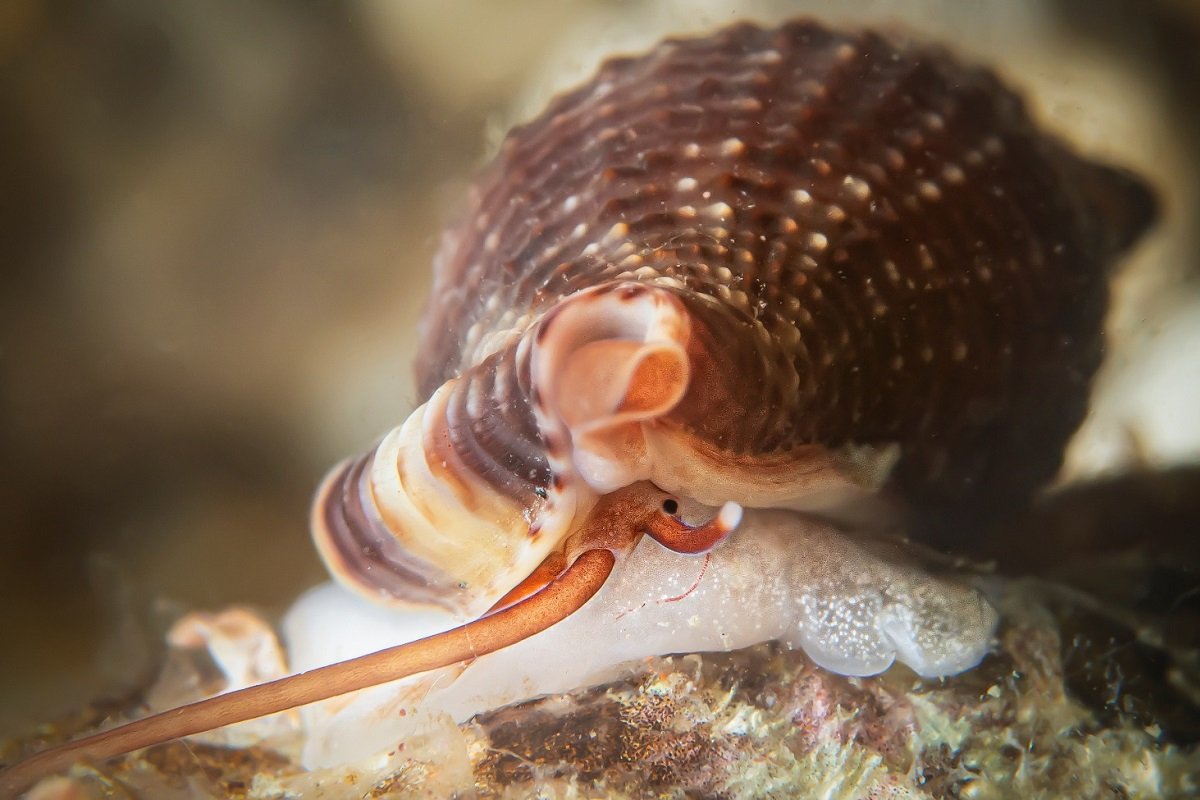
It was a real win for the little guy in this year’s Mollusc of the Year competition, in which Cumia intertexta beat much bigger beasts to win public support – despite a lifestyle many consider unpalatable. Just three centimetres long, the plucky contender, known for its spiralling conical shell, makes its living in an unusual way for a snail, by attaching itself to fish and sucking their blood.

Two long pointy snail houses of Cumia Intertexta
Cumia intertexta image by Marco Oliverio. Free to use

Secretive by daylight, and fond of shallow water, Cumia can often be found in rock pools and old shells litter popular holiday beaches. It’s commonly known as the Mediterranean vampire snail, and in traditional vampire style, it waits until darkness to leave its lair. Although its preferred prey is the parrot fish, it isn’t too picky. A long, tentacle-like extension with sharp teeth at the end enables it to latch onto them in the dark, but it’s not a brutal creature. It anaesthetises the fish so that they don’t notice its presence, and leaves them alive, improving its prospects for future feeding.

Clams, conches and more present tough competition

Winning the prize was no easy matter, as Cumia had to compete with four other fabulous molluscs selected by specialists and put up for a public vote. Ephippodonta lunata, an  Australian clam of a similar size, is known for its distinctive wiggle and intimate relationship with Axius plectorhynchus, the slow shrimp. Lithoredo abatanica is a Filipino shipworm with a taste for limestone and a curious resemblance to a used condom. The spectacular looking Triplofusus giganteus, also called the giant horse conch, hangs out around the southern coast of the US and the Gulf of Mexico, growing up to half a metre long, with a vivid orange shell in youth which gradually gives way to a more sophisticated pale grey or salmon pink as it ages.

If that weren’t enough, our neogastropod hero had to compete with Filicaulis seychellensis, aka the Seychelles white slug, a deceptively modest little creature which nevertheless saw the people of its island home rally behind it upon nomination. Unusually for a mollusc, it’s a pollinator, heaving its soft body, which resembles a sugary sweet, up flower stems at night to feed on delicious nectar. It also glows in the dark.

Amazing medical potential dazzles judges

What special talents did Cumia bring into play to fend off competition like this? It may have lacked the glamour and the dance moves of some of the others, but it really stood out in the research round, thanks to its sensational potential to help science. This is in part because of the aforementioned anaesthetic, which appears to work differently from those currently in use by humans, and might give us a new medical tool. Even more exciting in this regard is an enzyme it produces which can raise the blood pressure of its prey. As far as Cumia is concerned, this makes drinking easier, but it could have lifesaving applications in human medicine if it can be replicated, in part because of the speed of its effect.

Cumia intertexta: snail with long shell on the left of the picture, and a long proboscis attached to the throat of a fish on the right
Cumia intertexta feeding on a gobide image by Michele Solca. Free to use
Close-up of a camouflaged crustacean on a sandy, rocky seabed.
Cumia intertexta with long narrow house, feeding off a large scorpionfish image by Michele Solca. Free to use

Alongside these remarkable gifts, Cumia has its own special anticoagulant, which could also prove useful in medicine. It also has several novel proteins whose function is unknown, so there could be quite a bit of excitement ahead for the specialists who will now be studying it.

“By sequencing the vampire snail’s genome, we will obtain the first genetic blueprint for blood feeding in molluscs,” said Dr. Carola Greve of the Natural History Museum of Frankfurt. “ Her colleague, Prof. Dr. Julia Sigwart, added “We are thrilled that mollusc enthusiasts from all over the world have once again participated in the contest this year! The selection of the Mollusc of the Year is a fantastic opportunity to raise awareness of this fascinating – and, sadly, often endangered – group of animals. Our goal is to gain a deeper understanding of these impressive creatures so that we can better protect them and preserve their diversity for future generations.” 

Mediterranean vampire snail joins prestigious group

In accepting its prize, Cumia now swims alongside previous winners such as the deep sea octopus Muusoctopus, which lives in colonies off Costa Rica, basking in the warmth of hydrothermal vents; and Phuphania crossei, a Thai land snail whose distinctive green glow – which can be switched on and off like a flashlight – makes forests look magical by night.

The Mollusc of the Year contest is organised by the Senckenberg Society for Nature Research and global mollusc research society Unitas Malacologia. This was its sixth event.


Small bird, light brown with black neck and face and dark brown wings, and a cone-shape beak.
Climate Change

Climate change is affecting our wildlife. Can we help nature?

by Lily Peach
26 January 2025 - Updated on 4 March 2026
    Enjoyed that?  Why not buy us a coffee?

Friends of Bylines Network

There has never been a greater need for grassroots journalism that investigates the stories that really matter, holds power to account and champions the voices of everyday citizens. We are proudly powered by volunteers but what we do isn’t free.

STAND WITH US for independent, citizen-led journalism that makes democracy stronger, and you will even get some exclusive benefits.

BECOME A FRIEND
Tags: science
Previous Post

We found a lost copy of the earliest surviving English poem in a medieval manuscript in Rome

Next Post

Digital inclusion in Oldham: ambition, delivery and unanswered questions

Jennie Kermode

Jennie Kermode

Related Posts

People working in a field, carefully digging and looking for Roman finds
Cheshire

Roman villa excavation in Rossett reveals secrets

by University of Chester
7 October 2026
Signpost 'charity' against a blue skt
Education

Accounting students put their skills to work helping Manchester charities

by Manchester University
6 October 2026
a cross roads with traffic lights, and superimposed on the picture a collage of slug pictures
Greater Manchester

The case of the failing traffic lights in Stretford

by North West Bylines Reports
1 October 2026
Great End: Man hanging from a rope while he is climbing an icy mountain
Cumbria

Forty fells: Life in high places

by Eileen Jones
1 October 2026
Large building with arched windows
Greater Manchester

Breakfast Club in Wigan

by Anna Schurer
30 September 2026
Next Post
A young woman experiencing a headache while studying with a laptop indoors, looking stressed and overwhelmed.

Digital inclusion in Oldham: ambition, delivery and unanswered questions

SUPPORT OUR CROWDFUNDER

BROWSE BY TAGS

A day in my shoes AI by-election Charity Christmas coal mine Conservatives Coronation Cost of living Democracy Energy Eurovision EU support farming Festival Finance Gaza Homeless housing HS2 Labour Levelling up Liberal Democrats Long Read mayoral election minneapolis NI Protocol obesity poetry Poverty press release Press Releases recycle Reform Reviews riots Russia Satire SEND Sewage trans Ukraine water women xylb'tok
North West Bylines

We are a not-for-profit citizen journalism publication. Our aim is to publish well-written, fact-based articles and opinion pieces on subjects that are of interest to people in the North West and beyond.

North West Bylines is a trading brand of Bylines Networks Limited which is separate to, but allied with, Byline Times.

Learn more about us

No Result
View All Result
  • About
  • Authors and editors
  • Complaints
  • Contact
  • Donate
  • Letters
  • Privacy
  • Network Map
  • Network RSS Feeds
  • Submission Guidelines
  • Download the Bylines Network App

© 2022-2026 North West Bylines. Powerful Citizen Journalism. ISSN 3049-9755

No Result
View All Result
  • News
    • Crime and Justice
    • Education
    • Equality
    • Health
    • Migration
    • War
    • World
  • Politics
    • Brexit
    • Economy
    • Opinion
  • Environment
    • Nature and Wildlife
    • Pollution
  • Lifestyle
    • Art, Craft and Photography
    • Books
    • Culture, Language and Religion
    • Dance
    • Food and Drink
    • History
    • Music
    • Sport
    • TV, Film and Theatre
  • Business
    • Local Business
    • Technology
    • Trade
    • Transport
  • Region
    • Cheshire
    • Cumbria
    • Greater Manchester
    • Lancashire
    • Liverpool and Merseyside
    • Local Councils and Elections
  • Cartoon
  • Authors and editors

Newsletter sign up

CROWDFUNDER

© 2022-2026 North West Bylines. Powerful Citizen Journalism. ISSN 3049-9755