• Contact
  • About
  • ISSN 3049-9755
  • Authors and editors
NEWSLETTER SIGN UP
North West Bylines
Advertisement
  • Home
  • News
    • Crime and Justice
    • Education
    • Equality
    • Health
    • Migration
    • War
    • World
  • Environment
    • Nature and Wildlife
    • Pollution
  • Politics
    • Brexit
    • Economy
  • Lifestyle
    • Art, Craft and Photography
    • Cartoon
    • Books
    • Culture, Language and Religion
    • Dance
    • Food and Drink
    • History
    • Human Interest
    • Music
    • Sport
    • TV, Film and Theatre
  • Business
    • Local Business
    • Technology
    • Trade
    • Transport
  • Region
    • Cheshire
    • Cumbria
    • Greater Manchester
    • Lancashire
    • Liverpool and Merseyside
    • Local Councils and Elections
No Result
View All Result
North West Bylines
Home Environment

How I tracked the biggest hidden sources of forever chemical pollution in UK rivers

Patrick Byrne from Liverpool John Moores university is tracking high levels of forever chemicals in the Mersey

Patrick Byrne by Patrick Byrne
02-10-2025 07:22
in Environment, Pollution
Reading Time: 6 mins read
A A
Patrick Byrne stands in a river to sample for forever chemicals

Patrick Byrne samples the water in the Mersey catchment. Patrick Byrne, CC BY-NC-ND Patrick Byrne, Liverpool John Moores University

Share on Bluesky

The amount of toxic “forever chemicals” flowing into the River Mersey in north-west England has reached some of the highest levels recorded anywhere in the world.

My team’s research links much of this contamination to old landfills, waste facilities and past industrial activity. Even if these chemicals were banned tomorrow, they would continue polluting our rivers for decades, possibly centuries.

But there is a path forward. We’ve developed a new method to track and prioritise the largest sources for clean-up, giving regulators a clearer picture of where to act first.

Per- and polyfluoroalkyl substances (PFAS), more commonly known as “forever chemicals”, are a large family of human-made chemicals found in everyday products like food packaging, water-repellent clothes and fire-fighting foams. They are valued for their ability to resist very high temperatures and to repel water and oil, but these same properties make them extremely persistent.

Once released, some PFAS could take thousands of years to break down. They accumulate in the environment, build up – with different compounds accumulating at different rates – inside the bodies of wildlife and people, and have been associated with harms to health. The most studied types have been linked to cancers, hormone disruption and immune system problems.
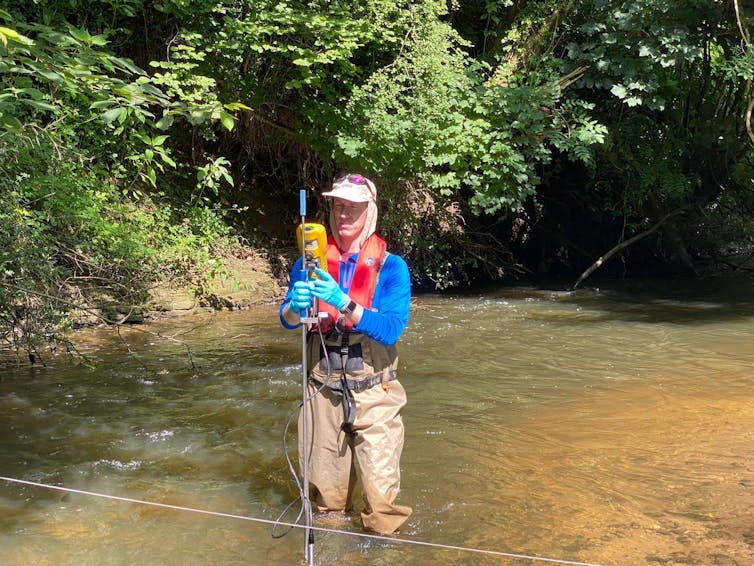
Patrick Byrne has been measuring PFAS ‘loads’ in rivers over a period of time, not just the concentration at one moment. CC BY-NC-ND

Last year, my research team discovered that the amount of two potentially cancer-causing PFAS chemicals washing off the land and into the Mersey was among the highest in the world. In our follow-on research, we travelled upstream to try and locate where these PFAS are coming from. But with hundreds of potential PFAS sources, how do we isolate the largest ones?

The secret is measuring something called the PFAS load – the total amount of PFAS flowing through the river at a given point, rather than just the concentration in the water.

Here’s why that matters: a small stream can have high concentrations but carry only a small total amount, while a large river with lower concentrations can be transporting far more PFAS overall. If we only look at concentration, we risk missing the really heavy polluters.

By measuring PFAS loads at multiple points along the Mersey system, we could see exactly where the largest increases occurred. That told us both the location and the scale of PFAS inputs.

We detected PFAS chemicals at 97% of our sample sites, even in supposedly pristine streams draining from the Peak District national park. But the big breakthroughs came when we matched the largest PFAS load increases to specific areas.

PFBS (a type of PFAS) was coming in huge amounts from land draining old landfills in the Glaze Brook watershed near Leigh, west of Manchester. PFOA, a globally banned and cancer-causing PFAS, appeared to originate from a waste management facility on the River Roch, north of Manchester. PFOS, another banned PFAS, was entering the River Bollin, with strong evidence pointing to historic firefighting foam use at Manchester Airport.

What’s most striking to me is that all these sources are rooted in the past – old landfills, waste sites or historic industrial use. These chemicals are no longer in production, but they are still escaping into the environment, decades later.

alt text
This unmanned survey vessel is packed with sensors that measure PFAS loads in large rivers. credit, CC BY-NC-ND

This is where PFAS load measurements make a real difference. Instead of chasing the highest concentrations – which might lead to cleaning up small streams that contribute little overall – we can target the sites releasing the largest total amounts of PFAS into our rivers.

It’s a simple idea with major implications. In a world where environmental regulators face tight budgets and limited monitoring capacity, knowing exactly which sites are the biggest sources is vital.

The Mersey is just one example. Around the world, PFAS contamination follows a similar pattern: numerous potential sources scattered across the landscape, many of them historical. The chemicals’ extreme persistence means they will continue cycling through rivers, soils and wildlife for generations unless active steps are taken to remove or contain them.

Our latest study shows that measuring PFAS load can help solve one of the toughest challenges in managing chemical pollution: working out where to start. By identifying and prioritising the biggest sources, regulators have a realistic chance of reducing the flow of forever chemicals into our rivers – and perhaps one day, making that nickname a little less true.

Patrick Byrne, Professor of Water Science, Liverpool John Moores University

This article is republished from The Conversation under a Creative Commons license. Read the original article.

The Conversation
Three people litterpicking on the bank of the River Mersey
Environment

Plans to clean up the River Mersey

by David Humphreys
8 March 2025
    Liked that article?  Buy us a coffee to say ‘thank you’
Previous Post

Brexit and populism – it is time to speak out against them

Next Post

A sacred day turned tragic: Two dead and four seriously injured in Heaton Park Synagogue attack

Patrick Byrne

Patrick Byrne

Professor of Water Science, Liverpool John Moores University

Related Posts

a cross roads with traffic lights, and superimposed on the picture a collage of slug pictures
Greater Manchester

The case of the failing traffic lights in Stretford

by North West Bylines Reports
1 October 2026
Great End: Man hanging from a rope while he is climbing an icy mountain
Cumbria

Forty fells: Life in high places

by Eileen Jones
1 October 2026
drawer full of old electronics such as calculators and leads
Environment

The coin desk: why we need to recycle e-waste

by North West Bylines Reports
23 September 2026
Screenshot of a google map showing the Dee Estuary with the small island group, only the largest one named on the map
Human Interest

Hilbre Island – can I cross or will the sea stop me?

by North West Bylines Reports
22 September 2026
Handing the petitions to a fake Andy Burnham. Photo credit: Sean McCrossan
Climate Change

Stop fanning the flames of the climate crisis, Mr PM!

by North West Bylines Reports
20 September 2026
Next Post
Building with Star of David above the main window

A sacred day turned tragic: Two dead and four seriously injured in Heaton Park Synagogue attack

SUPPORT OUR CROWDFUNDER

BROWSE BY TAGS

A day in my shoes AI by-election Charity Christmas coal mine Conservatives Coronation Cost of living Democracy Energy Eurovision EU support farming Festival Finance Gaza Homeless housing HS2 Labour Levelling up Liberal Democrats Long Read mayoral election minneapolis NI Protocol obesity poetry Poverty press release Press Releases recycle Reform Reviews riots Russia Satire SEND Sewage trans Ukraine water women xylb'tok
North West Bylines

We are a not-for-profit citizen journalism publication. Our aim is to publish well-written, fact-based articles and opinion pieces on subjects that are of interest to people in the North West and beyond.

North West Bylines is a trading brand of Bylines Networks Limited which is separate to, but allied with, Byline Times.

Learn more about us

No Result
View All Result
  • About
  • Authors and editors
  • Complaints
  • Contact
  • Donate
  • Letters
  • Privacy
  • Network Map
  • Network RSS Feeds
  • Submission Guidelines
  • Download the Bylines Network App

© 2022-2026 North West Bylines. Powerful Citizen Journalism. ISSN 3049-9755

No Result
View All Result
  • News
    • Crime and Justice
    • Education
    • Equality
    • Health
    • Migration
    • War
    • World
  • Politics
    • Brexit
    • Economy
    • Opinion
  • Environment
    • Nature and Wildlife
    • Pollution
  • Lifestyle
    • Art, Craft and Photography
    • Books
    • Culture, Language and Religion
    • Dance
    • Food and Drink
    • History
    • Music
    • Sport
    • TV, Film and Theatre
  • Business
    • Local Business
    • Technology
    • Trade
    • Transport
  • Region
    • Cheshire
    • Cumbria
    • Greater Manchester
    • Lancashire
    • Liverpool and Merseyside
    • Local Councils and Elections
  • Cartoon
  • Authors and editors

Newsletter sign up

CROWDFUNDER

© 2022-2026 North West Bylines. Powerful Citizen Journalism. ISSN 3049-9755